

Have a Honey Deuce and Enjoy a New, Queer Tennis Romance 🎾
What Else?: A conversation with Edward Schmit, author of THE OPEN ERA
Hot take: Summer kind of sucks.
Before you go switching tabs/deleting this email, hear me out. I know a lot of warm season propaganda will tell you that it’s great. That it’s the time for enjoying meals outside, heading to the beach, and taking long sunny days a little bit slower. It’s baseball games and ice cream trucks, bleached hair and cold beer, tanned skin and sundresses and flip-flops. Basically, nothing but lazy, hazy, crazy fun.
Some of this is true. But it’s also the season for other things. Like bug bites and sunburn. Or filling in for your colleagues as everyone else goes on vacation. It’s the time when all restaurants will inevitably have at least one screaming child, out too late with their parents while off from school. The days where the best word to describe them is usually “sweaty.” And, if you live in a place worth visiting, it means your city or town is probably going to be filled with more tourists. People who take selfies in the middle of the sidewalk, blocking the path and making you late for that crowded, child-filled dinner reservation you booked at an outdoor hotspot weeks ago. Back when it was damp and cold and you wondered if it would ever get nice out again.
After experiencing New York’s unseasonable heatwave last week, I returned to London hoping for some relief. Instead, the temperatures here are so steep that they’re not just setting records, they’re also cancelling trains, selling out fans/AC units, and even sending some more vulnerable residents into hospital. My Notting Hill maisonette has been 28°C1 for days; too warm to do anything but sit still on the couch with my water bottle, letting my body melt. Occasionally, I’ll remember the outside world and look out my front window. There, I see determined Portobello Market shoppers still strolling along, dumping bottles of water on their sun-drenched heads to cope. I can’t imagine they’re having fun; that endless days of this is enjoyable for anyone, even people who live in a place where it rains roughly one third of the year.
Some of you might call me a Summertime Grinch. Which, fair enough. But I think it’s more that my definition of warm weather fun is limited and specific. I like long, hot days, but only if there is a body of cool water nearby. I like eating outdoors, just not if a bee lands in my food, making the meal a real buzzkill. And while I will hate navigating crowded, steamy public transit to get anywhere, I always love catching up with a friend over a nice drink: an Aperol Spritz in June, frosé in July, or a crisp Honey Deuce at the tail end of August
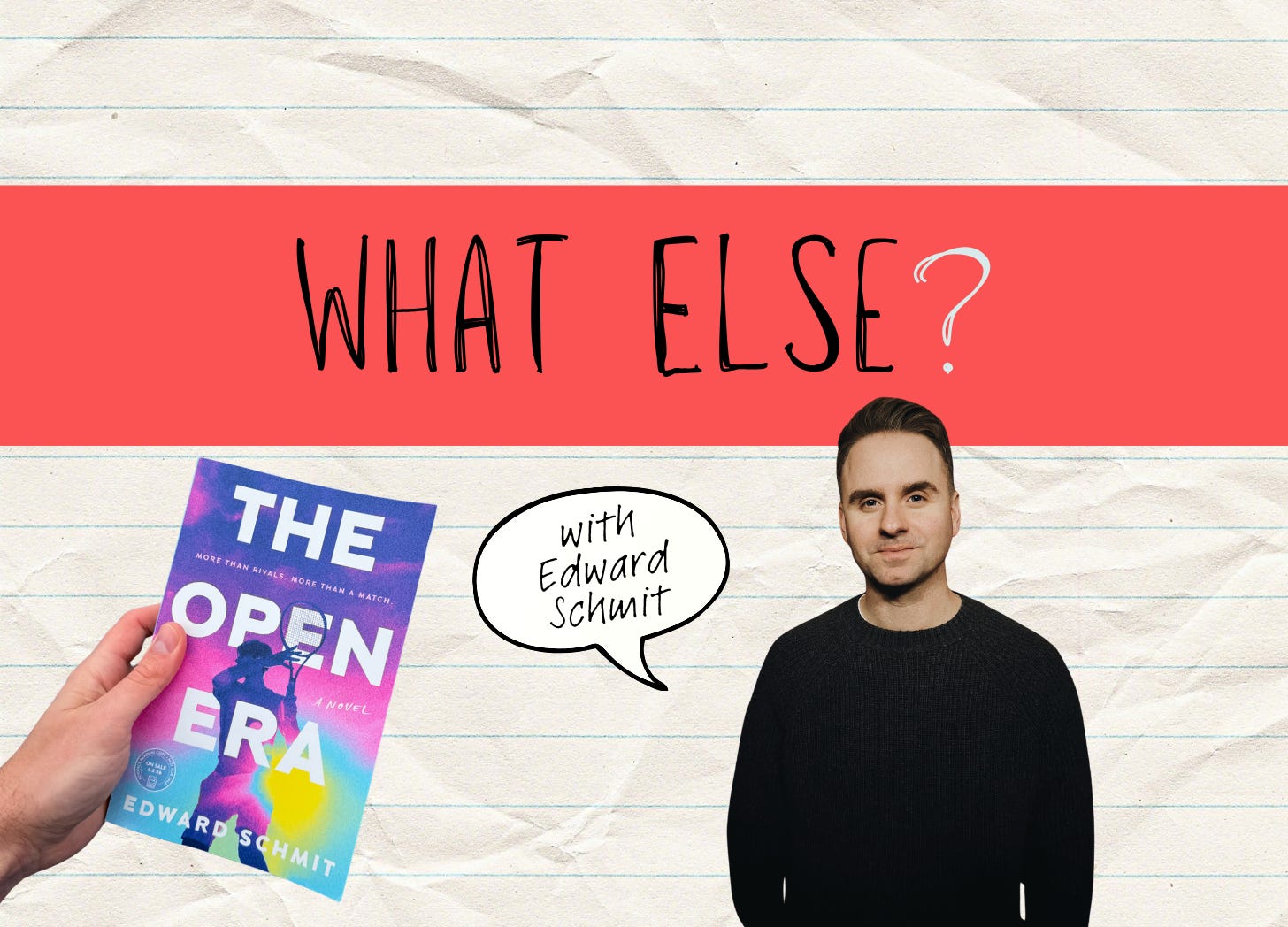
Someone who knows their way around a good honey deuce is debut author Edward Schmit, whose novel The Open Era publishes next Tuesday.
Leading man Austin Hardy is the first openly gay male competing in a Grand Slam tournament, which means there is a lot of pressure sitting on his shoulders. The overwhelming number of news headlines pointing this out don’t help Austin’s anxiety disorder. Neither does the fall he takes at practice, landing him right at the feet of his (very attractive) rival, Diego Cruz. However, the interaction leads to the pair striking up a friendship—and possibly more—as they prepare to compete at the US Open. It’s a fun, flirty story of queer desire as well as a poignant look at the mental toll competition takes on athletes. It’s a must-read for anyone who devoured Rachel Reid’s Game Changers series after watching Heated Rivalry this past winter and is now in need of a summer counterpart.
Edward told me how he came to love tennis and how this passion sparked the initial idea for The Open Era. He also shares his feelings about pickleball, the details of his teenage spec script for Friends2, plus a little taste of what readers can expect from him next summer.
What do you do outside of reading and writing?
I’m going to be annoying and talk about tennis a lot because that really is what I do outside of writing. I won’t say my first book happens to be about tennis because it was the tennis part that came first: playing, watching, reading about it.
A lot of my time, especially in the spring and summer, is spent playing tennis. It’s hard to make friends in the city. You have your little circle, but if you’re not going into an office, which I haven’t since 2019, it’s hard to meet people. So, I found a nice little community in New York with tennis.
Why tennis? Did you play as a kid?
I was a theatre kid growing up. I had zero interest in sports. It’s wild that I wrote a sports romance. If I went back in time and told my middle school self starring in Dracula that I was going to love sports one day, that kid would tell me to shush.
My dad loves tennis. He tried to get me to play many times. I had no interest. But when I moved to New York, I started going to the US Open for the vibes. I did that for many years and it got to a point where I was looking for ways to work on my mental health. A great way to do that is by working on your physical health. I still wasn’t a sports guy. I didn’t even like going to the gym. But I thought: I like watching tennis, why don’t I try playing? It all sort of went from there and spiralled into an obsession.
I tried tennis lessons years ago. It went… not great.3 Do you have any advice for someone trying to learn the sport?
You start off playing tennis and you’re terrible. I’m still terrible, just a little bit less. It’s a lifelong sport. It takes forever to get good.
It’s a lot of time on the court and sitting with being bad at something. I think many of us have a hard time with that. As a shameless perfectionist, I still struggle. It really is uncomfortable not to pick something up off the racket, so to speak.
My advice is to stick with it and try to find the little joys. Like when you’re chasing a great shot and then you hit one once or twice. It will feel great. The rest will be terrible, but enjoy what goes well and know the next time you come back, you’ll hit more. Just have fun being outside with people.
Would you say pickleball and badminton are good gateway sports to tennis?
I play neither. But there are definitely rivalries between tennis players and pickleballers.
Really?
It’s because pickleballers take over tennis courts. I’m not coming down on a side here. I think anytime you’re outside and having fun with friends and getting exercise, that’s amazing. Pickleball has done that for so many people. But I think most people would agree that tennis is infinitely harder. It’s a much bigger investment to play and actually be good. Whereas pickleball you can pick up the paddle and immediately have a great time.
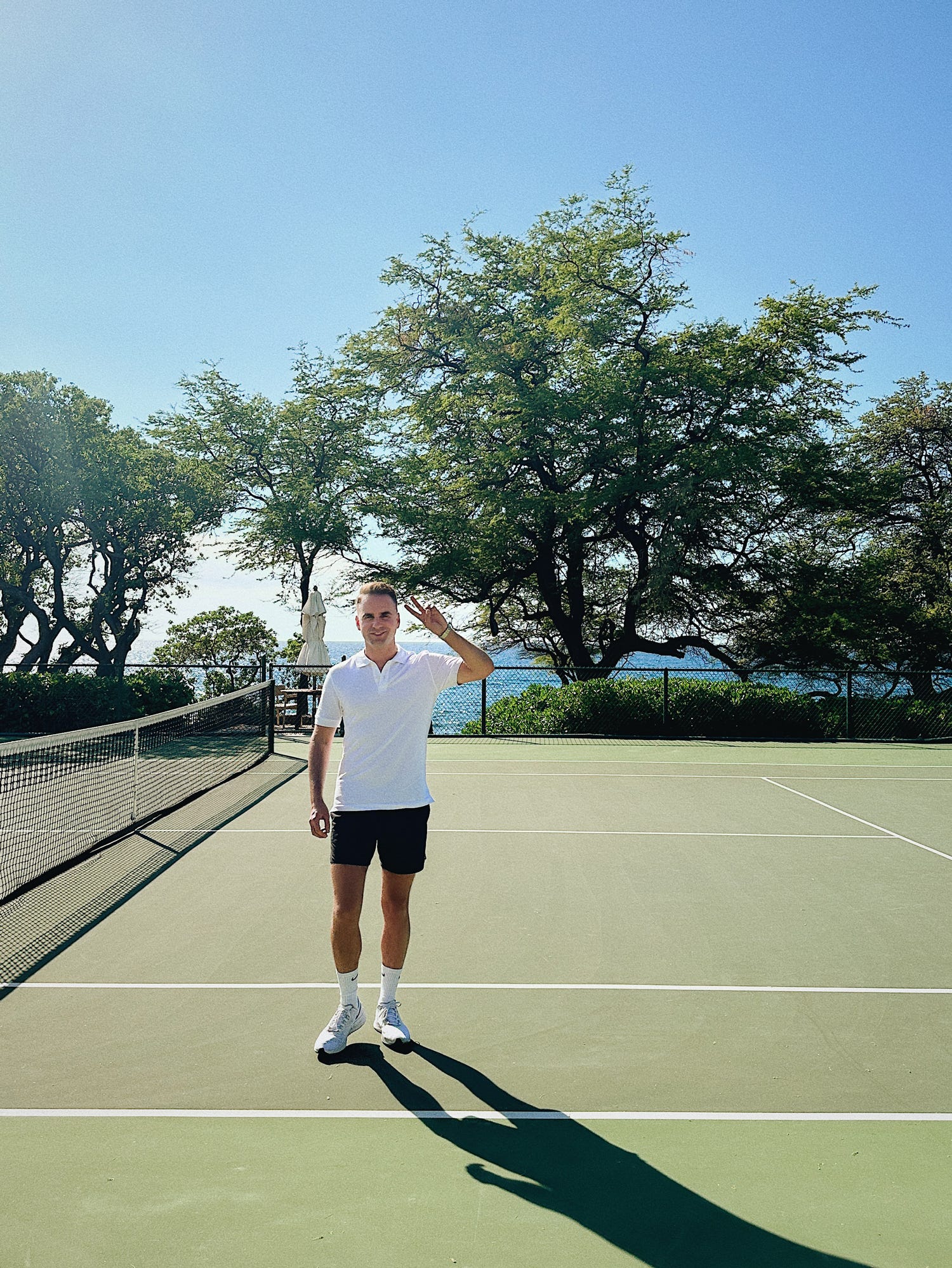
In addition to playing, you said that you watch a lot of tennis. Can you explain to me why the sport is played on different surfaces? Do they meaningfully impact the game?
Having the different surfaces makes the sport so much more interesting. Every other sport takes place in the same place regardless of competition. But the ball in tennis bounces completely differently on hard courts versus grass versus clay. In order to be a great tennis player, you have to figure out your game on each surface, which complicates things.
It’s wild that the sport changes how it’s played throughout the year. I can’t think of another that does that. It really is year-round. Players are away from home for 11.5 out of every 12 months.
Do you have a favorite tennis competition?
My favorite tournament without question is the US Open. The energy there is unmatched. There’s also a lot more space. It fits a bunch of New Yorkers alongside people travelling from all over the world.
The set-up is amazing. It’s basically turned into a three-week tournament now. There are two weeks of actual tournament, and then the week before called Qualifying Week, or Fan Week. It’s free to walk in and watch the qualifying matches from the very front row; a great experience for zero dollars. That’s pretty hard to find in New York.
Wimbledon is also amazing. There is the prestige; the silence of watching those matches. The grass kind of absorbs the sound. It’s a completely different experience.
I know the US Open has the Honey Deuce. And Wimbledon has strawberries and cream with a Pimm’s Cup. Do other tennis competitions have notable snacks?
Those are the only two Grand Slams I’ve attended, so I cannot speak to the French or Australian Opens. I know other 500-level tournaments are introducing their own drinks. I think there is the Paloma Ace at the Miami Open. It’s kind of hard to match the Honey Deuce, though.
They’re so expensive!
Upwards of $20 now.4 You’ll see folks with very large towers made from their commemorative cups, too, walking around, casually holding onto $1,000 worth of enjoyed cocktails.
You’ve been to two of the big competitions. Do you have any others on your bucket list?
I have to complete a career slam, meaning I need to go to all of the Grand Slams. I’ve also gone to a lot of the bigger ones: Miami and Indian Wells, which is a great one in California. Liking tennis and wanting to go to tournaments is a fun way to see the world. It takes you to interesting places.
I know Carlos Alcarez and Jannik Sinner are the two big names in men’s tennis right now. Do you fall on either side of that rivalry?
I think the general consensus in tennis right now is mostly gratitude for having two guys who rose up now that the big three5 are retiring. I’ve been very fortunate to see both of them a few times. They’re amazing players. It would be hard to pick my favorite because they offer such different things to the sport.
Sinner is a machine. He gives you nothing, whether it’s the press or during a match. He’s just zeroed in. I have a lot of respect for that. It’s why he’s so good. On the other hand, Alcarez lets you see he’s having fun. He’s putting his hand to his ear to try to get more from the crowd. I think he’s probably more fun to watch, but I like them both very much.
What about the women’s game? Do you have any favorites?
I love Coco Gauff. Aryna Sabalenka is another fun one to watch. Naomi Osaka, too, of course. She is giving us all the fashion. There’s room for more of that, too. When you walk out the tunnel, it’s your moment to look and feel how you want.
Is there anything outside of tennis you enjoy? You mentioned being a theatre kid. Are you a theatre adult?
I was an acting major in school, then I moved to New York and promptly retired. I just didn’t see it in the cards for me. But I love still going to the theatre, as well as watching film and TV. A lot of my friends are actors and I love supporting them.
Do you have any show recs?
Maybe Happy Ending. It’s perfectly directed with wonderful music. It’s a very touching story about two robots falling in love. Death Becomes Her is also an incredible fun and funny time.
I’m really into eating out in New York, too. I live in Astoria in Queens, a huge foodie neighborhood. There are many incredible Greek restaurants. Taverna Kyclades is probably my top choice. And I go out in the West Village a lot because it’s a nice, central point for my friends who live off the L train or in New Jersey. We’ll go to The Commerce Inn, which is tucked away; a Shaker-style, American fare place.
Were you a big writer before drafting The Open Era?
I was always writing things, like little plays. We had this exercise in high school where we had to write an episode of a TV show, so I drafted a spec script for Friends with a friend. My teacher thought it was pretty good. She wanted us to send it to the writing team at the show. Of course we never heard back. I think they were good on writers.
I wrote two screenplays in college. I never considered writing a novel, though, until this idea. Because of the interiority of the character, I knew it had to be a first-person narrative with you inside Austin’s head. I wanted readers to hear his thoughts; to be living alongside him and his anxiety.
As a big Friends fan, I need to know: what was your episode about?
The only thing I remember was Phoebe swapping her acoustic guitar for an electric one before booking a kid’s birthday party. Chaos ensues. I don’t remember any of the other plots; just Phoebe screaming hardcore rock in front of young children.
Let’s talk a little bit about the book. Where did the idea come from?
When I started watching tennis, I didn’t know who most of the players were. I was looking for openly gay players to support. There are a few women, but there are zero men.
It felt strange to me. I couldn’t get the question out of my head. I started thinking about what it would be like as a story, and I imagined mental health must be a major component. I have a background working for mental health nonprofits. It’s also a very important piece of my own identity, living with anxiety. I wanted to infuse a piece of that into whatever story came.
When you’re the first of anything, attention goes to you and that can take a toll. Tennis is already a mentally taxing sport. It’s just you out there on the court. You can really beat yourself up.
Why a romance novel?
Hey, you’ve got to put your characters through some turmoil!
Austin has an anxiety disorder. He’s the first openly gay male tennis player to compete in a Grand Slam. All that pressure of being a token, gay athlete is put on him. So, I wondered: what else could go wrong? Obviously, he has to fall in love with his rival.
The romance was another interesting way to explore his psyche. I think of the book a lot as a three-ring circus: the tennis competition, the mental health component, and the romance. They’re all at odds with each other, which makes for a compelling story.
The exploration of mental health in the novel is poignant, particularly when it comes to athletes and queer people. How do you feel about the representation of these topics in fiction generally?
I’m happy to see mental health becoming more of a theme in books across genres. It’s important for people who are struggling to feel less alone and to see themselves in characters.
I think our job as writers is to show people flaws and all. When people fall in love, you should fall for the whole person. And for many people—1 in 5—that includes a mental health condition. Also, falling in love is stressful. It brings out tons of self doubt, wondering if you’re worthy of being loved.
Including all of that in the book came naturally to me. I tried to include a lot of myself in the story, too. A lot of Austin’s symptoms are quite similar to mine. It’s the way I brought authenticity to the story. I think early readers have picked up on it. I can’t imagine a world where I’m building characters who don’t address their mental health in some way.
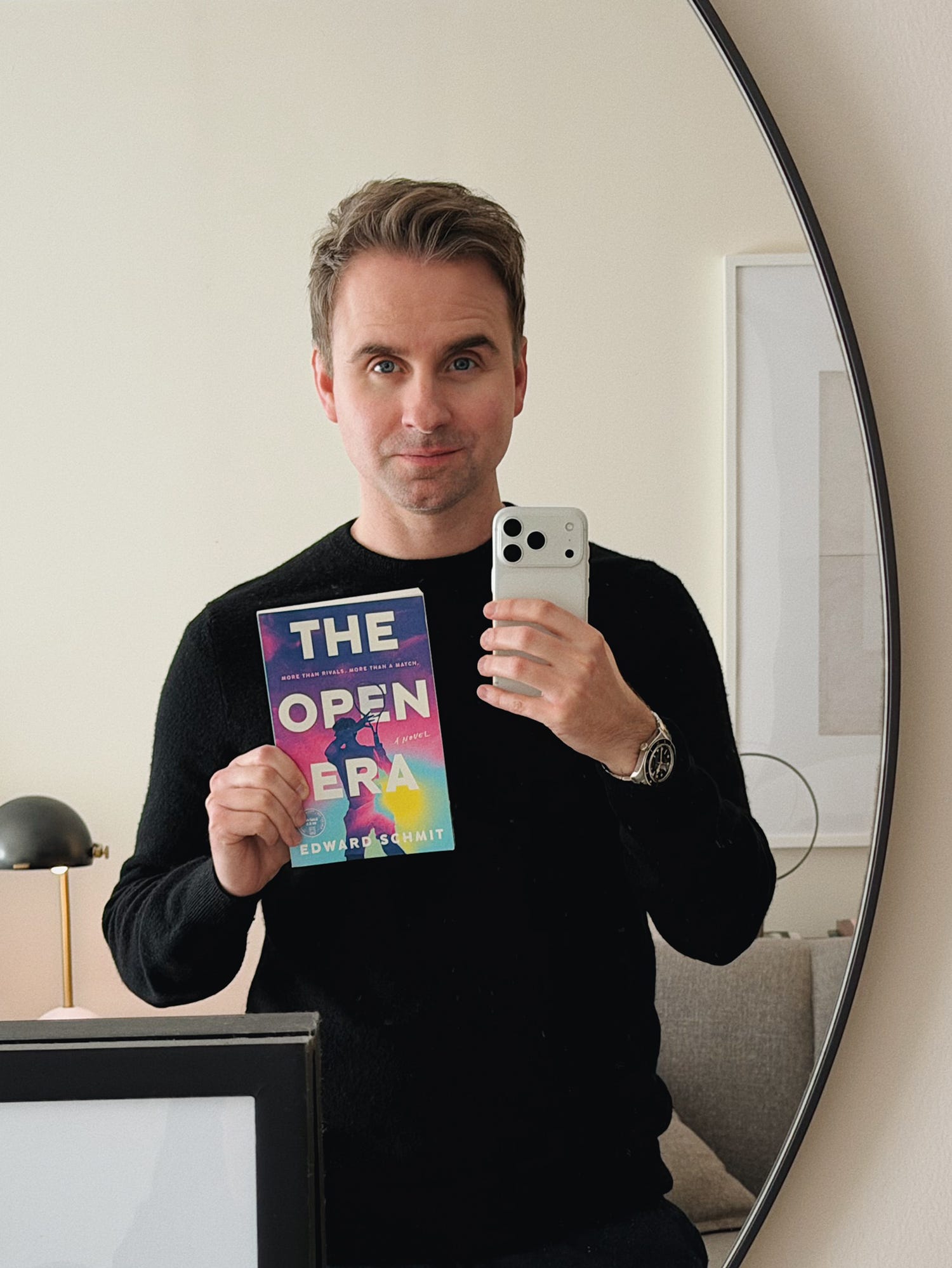
I like to ask debut authors how they’re feeling ahead of the big day. What are you excited about?
I’m stressed and excited about so many things. That’s how my brain works, always.
I’m excited for people to read it. You sit for a year alone living with these characters and it’s a joy to see people finally meeting them, liking them, and relating to them. We’re doing the launch at The Strand, one of my favorite bookstores, so that’s a vision board dream come true. It’s all brand new and I’m learning lots of things for the first time. My new writer friends are helping me through it.
What about Book 2? Can you tell me anything about what’s in the cards for that?
My next project is also a queer romance. Not sports, but it is another fun, summer adventure. That’s all I can say for now, but get ready in 2027.
Edward Schmit is an author based in New York City. From theatre kid to graphic designer to creative director, he’s always exploring new ways to tell stories. A passionate mental health advocate, he’s worked in the nonprofit space for more than seven years. The Open Era is his debut novel and combines three things close to his heart: queer love stories, mental health awareness, and the most beautiful sport in the world: tennis.
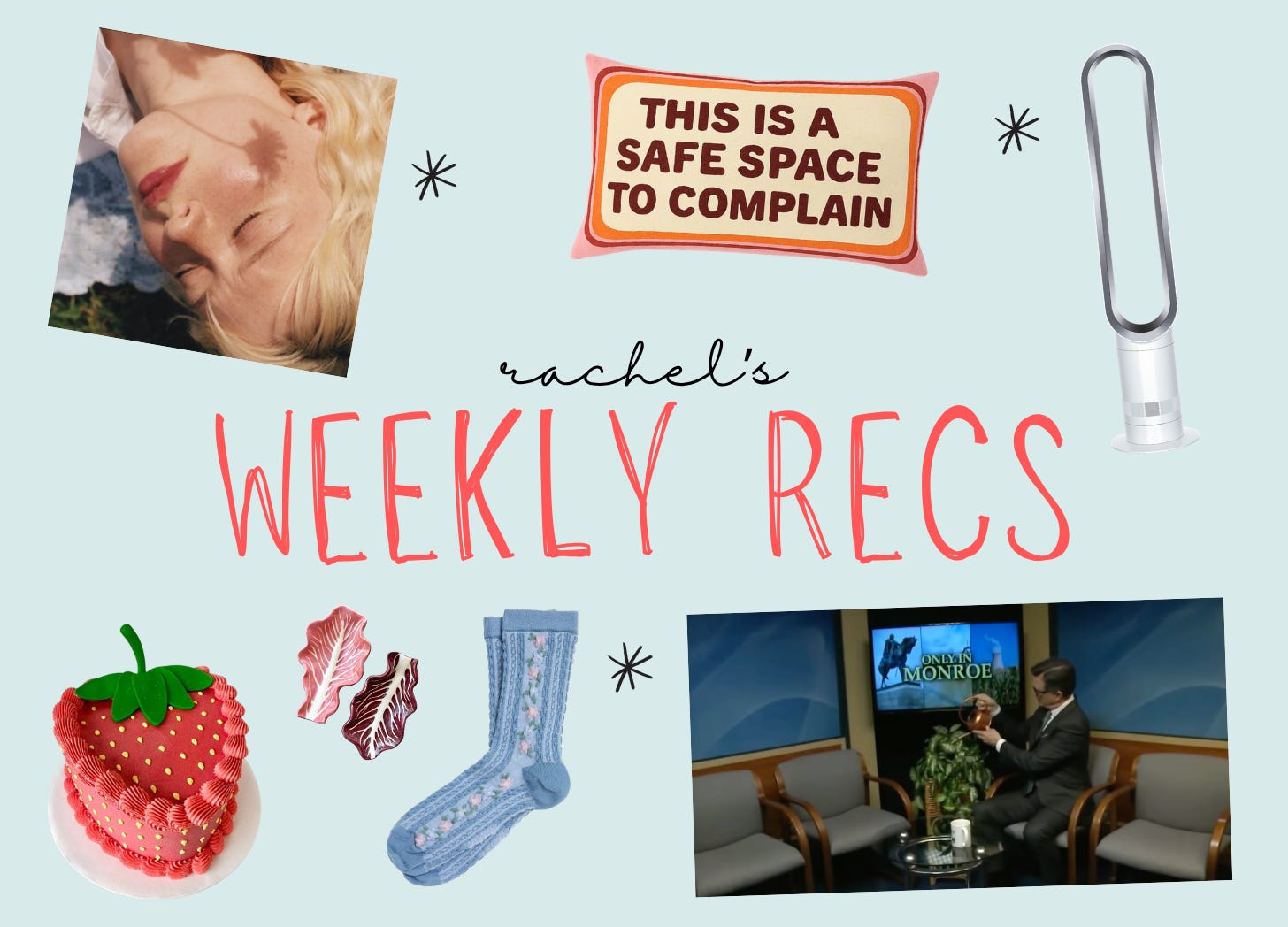
I had to splurge on a good fan to quell the London heatwave. I’ve been hesitant to commit to a Dyson, but it indeed lives up to its steep price tag. Most especially when AC is not available.
Maisie Peters released her third album Florescence last Friday. It’s the perfect listen for any girlies out there who are going through any twentysomething growing pains and/or falling in love for the first time.
Stephen Colbert has sadly taken his last bow on The Late Show. And his next chapter looks to be… public access television? ICYMI, check out Stephen stepping up to guest host Only in Monroe, a local Michigan public access news program. If his new YouTube page is any indication, CBS can try to cancel him but Colbert isn’t going anywhere.
About 84°F
It would definitely be called “The One With the Electric Guitar”
As in I was asked to leave class and try swimming instead
$23, to be precise
Novak Djokovic, Rafael Nadal, and Roger Federer
my season ranking is Fall, Winter, Spring, then Summer